
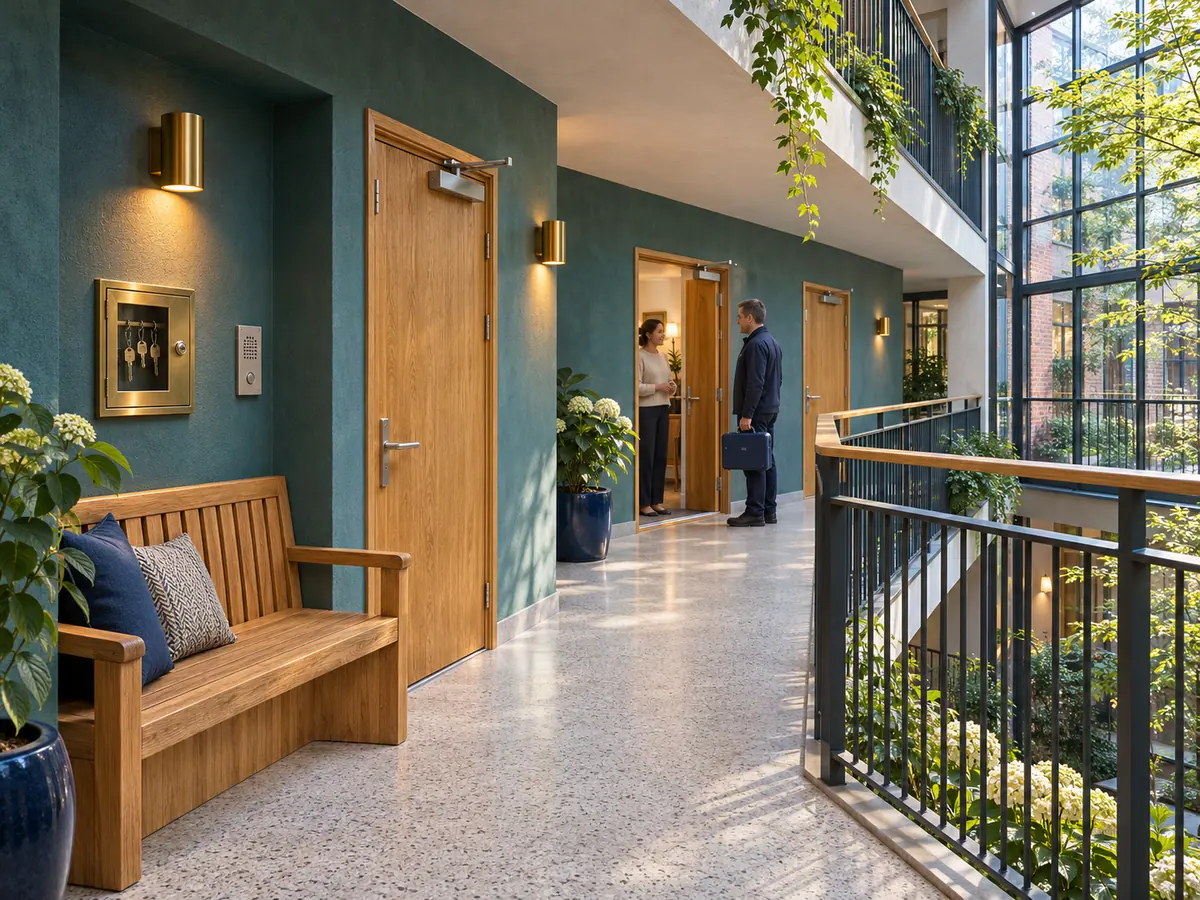
How should managing agents organise resident access for fire door visits?
Explain the purpose, arrange convenient authorised appointments and give residents a clear way to respond or request adjustments. Keep an asset-level record of invitations, agreed visits, attendance and unsuccessful attempts. Escalate unresolved access through the proper management and legal routes while separately assessing any known risk; never record an unvisited door as satisfactory.
Flat entrance door work combines building safety with access to someone's home. A technically sound programme can still leave important gaps if appointment messages are unclear or residents cannot attend the offered window.
This guide describes an access process for managing agents and property teams, rather than advice about gaining entry. It covers planning, communication and records for checks or specialist inspections, whose scopes should remain distinct. Specific checking duties discussed apply to relevant residential buildings in England under the Fire Safety (England) Regulations; contractual access rights and other housing responsibilities require separate consideration.
In this guide 5 sections
Read the guide offline or copy its planning points into your own records.
Download this guide as textExplain what the visit is for
Tell residents whether the appointment is a simple check, a specialist inspection or remedial work. Explain which door is involved, who is attending, why access is requested and approximately what participation is needed. Use plain wording and provide a contact that can answer practical questions.
Avoid implying that every visit issues a product certificate or that the resident must agree to unspecified works. If the scope may identify a need for later work, explain that separately. Give enough information for residents to recognise a legitimate appointment, including how to verify the contractor through the managing agent. This also reduces confusion where another supplier is working in the building at the same time.
Design appointments around the residents
Use the contact information held through appropriate property-management processes. Offer a clear booking method and record reasonable needs such as accessible communication, interpretation or a carer's involvement. Do not assume a standard daytime slot is workable for everyone.
Group appointments where practical, but leave a route for individual arrangements. Explain any requirement for an adult or authorised representative to be present, and clarify how keys are handled if a lawful alternative arrangement is agreed. Keep personal access information protected and available only to people who need it. Operational convenience does not justify entry without proper authority or disregard for privacy.
Keep a useful access history
Use the door's asset reference alongside the flat address. Record when invitations were sent, the communication method, responses, confirmed appointments and attendance. Distinguish no response, cancellation, no one present, explicit refusal and a contractor unable to attend. These are different problems requiring different next steps.
In specified residential buildings above 11 metres in England, the Responsible Person must use best endeavours for flat entrance fire-door checks at least every 12 months and keep the required record of steps taken, including unsuccessful access attempts. A dated record supports that process. A template that says only 'no access' is less informative than a factual history with a planned follow-up.
Give unsuccessful appointments a next action
After a missed appointment, confirm what happened and offer the appropriate next step. A resident may not have received the message, may need another time or may have concerns about the visit. Use the reason, where known, to improve the arrangement without recording unnecessary personal detail.
Persistent refusal or unresolved access should go to the person able to consider the relevant lease, tenancy and legal position. The checking duty does not create a general permission for forcible entry. Keep that escalation separate from any technical response to a known door concern. If an important defect is already reported, obtain competent advice about the building's risk rather than simply waiting for the next routine appointment campaign.
Close the campaign with an honest coverage report
Report completed visits and the remaining unvisited doors separately. For each outstanding door, show the access history, current owner and next step. A contractor's completion of the booked day is not completion of the entire door population.
Send residents any relevant next communication, including a clear process for reporting damage or arranging an agreed return visit. Transfer technical findings into the defect register with the same asset references. Review why access failed across the programme: confusing messages, outdated contacts or unsuitable appointment windows can be improved. Preserve the campaign history so the next manager can continue it without asking residents to repeat the same explanations.
- Visit purpose and identity explained
- Booking and adjustment contact provided
- Each invitation and outcome recorded by door
- Remaining access issues owned and escalated
- Coverage reported separately from attendance
Fire door inspections questions.
Does best endeavours mean one letter is enough?
There is no universal one-letter rule. Keep a factual record of appropriate efforts and follow-up for the circumstances, using the Home Office guidance and relevant professional advice where access remains unresolved.
Can a contractor record a door as passed from outside?
Only the work actually completed can be reported. If access needed for the agreed check or inspection was unavailable, the report should state that limitation rather than imply a complete result.
Should residents receive the whole building report?
Provide information through the applicable duties and management arrangements. Individual appointments and findings should be communicated clearly, while personal data and security-sensitive material need appropriate handling.
Managed blocks, communal areas and residential property portfolios.
Residential block fire risk assessments →Find the relevant service details, access considerations and information to include in an enquiry.
Care homes: inspection planning →Find your site area →Prepare a site inspection list →Sources used for this guide.
The linked guidance supports the factual context. Check its jurisdiction and the requirements for your actual premises.
- Fire Safety (England) Regulations 2022, regulation 10 ↗
England only: specified residential fire-door checks, best endeavours and access records in buildings above 11 metres.
- Home Office fire door guidance ↗
Distinguishes simple checks from specialist assessment and discusses defects, access and evidence in England.
- Reaction Group: fire door inspections ↗
Current service page confirms inspection offering and communication of critical issues; agreed scope governs any appointment.
Fire door inspections: scope & records.
See what the service includes and which site details help prepare a relevant quote.
View the service details