
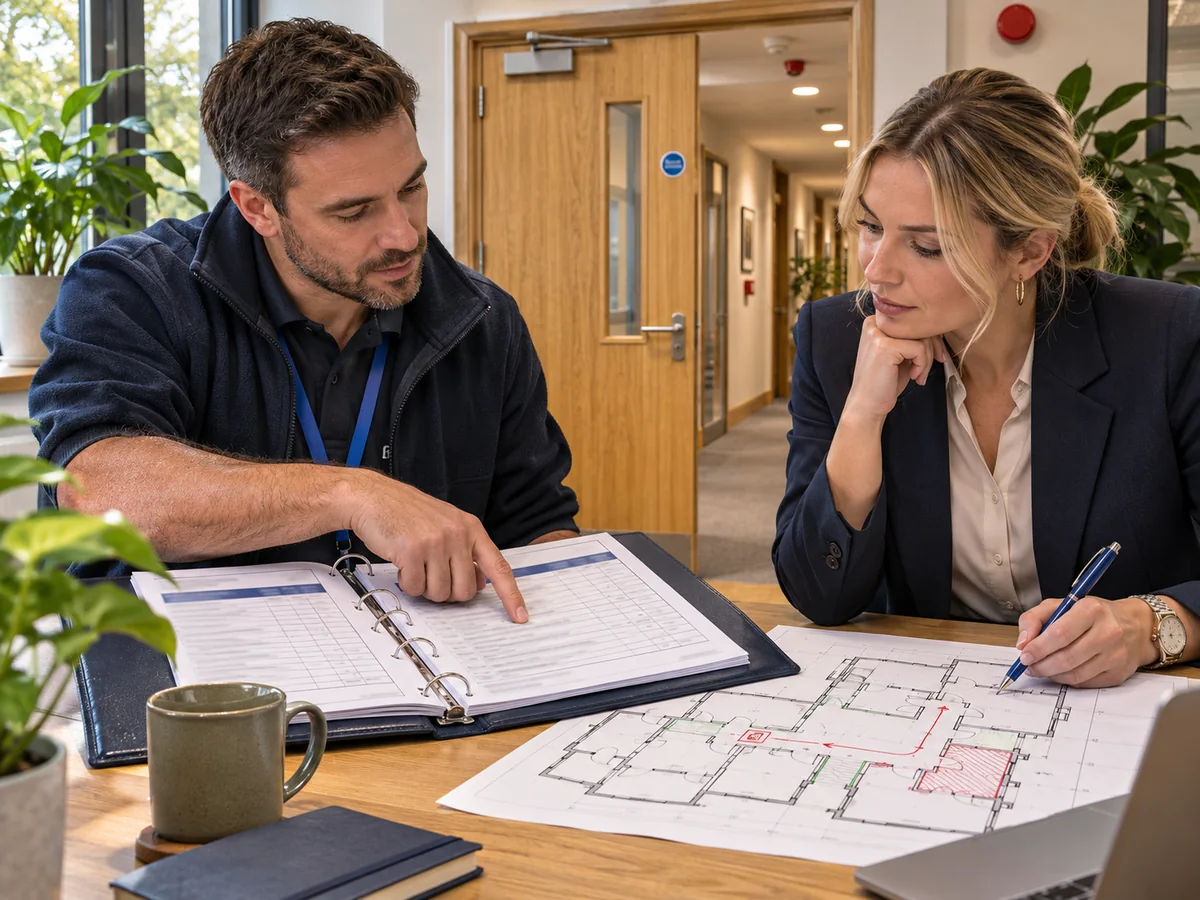
How should fire risk assessment findings become a manageable action plan?
Give every finding a traceable reference, named owner, risk-based response and evidence requirement. Preserve the assessor's wording, then record the management decision and progress separately. Treat a quote, purchase order and completed repair as different stages. Close an action only when suitable evidence shows the required outcome has been achieved.
A report can describe risk clearly while the organisation still struggles to act. Findings may cross landlord and tenant boundaries, require different specialists or depend on access that has not been secured.
A useful register makes those dependencies visible. It is a management tool, not a replacement assessment or permission to postpone urgent action. The method below suits commercial buildings and portfolios where procurement, site staff and senior managers all need to understand the same position. It can be a spreadsheet or part of a property system, provided the records remain readable and the underlying evidence is easy to retrieve.
In this guide 5 sections
Read the guide offline or copy its planning points into your own records.
Download this guide as textKeep the finding and the decision separate
Copy the report reference and a faithful summary of the finding into the register. Retain the source report and its version so the action still makes sense after a later assessment. Avoid rewriting a specific defect as a broad task such as 'review fire safety'. That loses the location and the intended result.
Next record the management response. It may be a repair, a change to an operating procedure, specialist advice or clarification from the assessor. If the response differs from the recommendation, retain the competent reasoning and the person approving it. The register should make the decision understandable without pretending that a spreadsheet entry is itself a technical justification.
Assign an owner who can move the work
Use a named person with the authority to organise the next step. 'Landlord', 'maintenance' and 'contractor' are useful parties, but weak owners when nobody is accountable for following up. Show who commissions the work and who controls access, particularly where those are different people.
For shared premises, record the boundary of responsibility and the communication with other dutyholders. A tenant may control a room while the landlord controls the protective system serving it. Do not leave an action unowned while that discussion continues. Give someone responsibility for resolving the allocation, with a recorded next step. Any immediate safety concern needs prompt escalation through the building's arrangements.
Use dates that reflect risk and dependencies
Retain the assessor's priority and recommended timescale, including any need for immediate action. Ask for clarification where the report is unclear. Procurement lead times are information for managing the response, not a substitute for evaluating whether the existing position can safely continue.
Record interim measures only where they have been properly considered for the circumstances. Give them an owner, start date and review point. A temporary arrangement can become invisible if it sits in a comment field after the permanent repair is delayed. Flag dependencies explicitly: access agreement, technical design, specialist investigation, approval and verification. Each should have a next action rather than a vague 'awaiting works' status.
Specify evidence before ordering the job
Tell the contractor what must be demonstrated at completion. Depending on the task, useful evidence may include an asset-specific report, photographs, test results, installation information or a revised procedure with staff briefing records. The evidence should answer the original finding, not merely confirm that someone attended.
Consider a reported door-closing defect. A quotation describes proposed work; an invoice records a commercial transaction; a completion record should identify the door and what was checked after the work. None should be silently substituted for another. Technical verification must be suitable for the task and carried out by someone with the necessary competence. Keep the register's acceptance decision distinct from the contractor's statement.
Review the unresolved position, not just percentages
A dashboard showing a high closure rate can hide one important unresolved issue. Review overdue actions, repeated defects, incomplete access and interim arrangements as separate groups. Grouping findings by property or contractor helps procurement, but retain the original asset and risk references.
At each review, record what changed, what remains uncertain and the next decision. If a finding recurs after closure, reopen or create a linked action rather than deleting the earlier history. In England and Wales the assessment and fire safety arrangements need records; a clear action trail helps demonstrate how findings are being managed. It also gives a successor a usable account of unfinished work.
| Field | Example of useful content |
|---|---|
| Reference | Assessment version, finding number and precise location |
| Response | Required outcome, owner and risk-based timing |
| Status | Investigation, approval, works or verification |
| Closure | Evidence link, verifier, date and remaining limitations |
Fire risk assessments questions.
Can the contractor close an action?
They can supply completion evidence. The property team should agree who reviews that evidence and accepts closure, with technical advice where needed. Attendance alone is insufficient.
Should every finding have a separate purchase order?
Not necessarily. Related work can be procured together, but each finding should remain traceable so partial completion or an inaccessible asset cannot disappear inside a larger order.
What if the recommended work is disputed?
Obtain clarification or competent technical advice and record the reasoning. Keep the issue visible while it is resolved, including any necessary immediate response and review of interim arrangements.
Changes, outstanding actions and existing assessment enquiries.
Existing fire risk assessment →Find the relevant service details, access considerations and information to include in an enquiry.
Find inspection advice for your industry →Find your site area →Prepare a site inspection list →Sources used for this guide.
The linked guidance supports the factual context. Check its jurisdiction and the requirements for your actual premises.
- Fire safety duties under section 156 ↗
Full assessment and arrangements records, assessor identification, cooperation and successor information.
- Fire Safety Order, article 9 ↗
England and Wales: suitable and sufficient assessment, review triggers and recording.
- Home Office: Fire Safety Order enforcement supplement ↗
Explains cooperation records and relevant information passed between successive Responsible Persons.
Fire risk assessments: scope & records.
See what the service includes and which site details help prepare a relevant quote.
View the service details

